
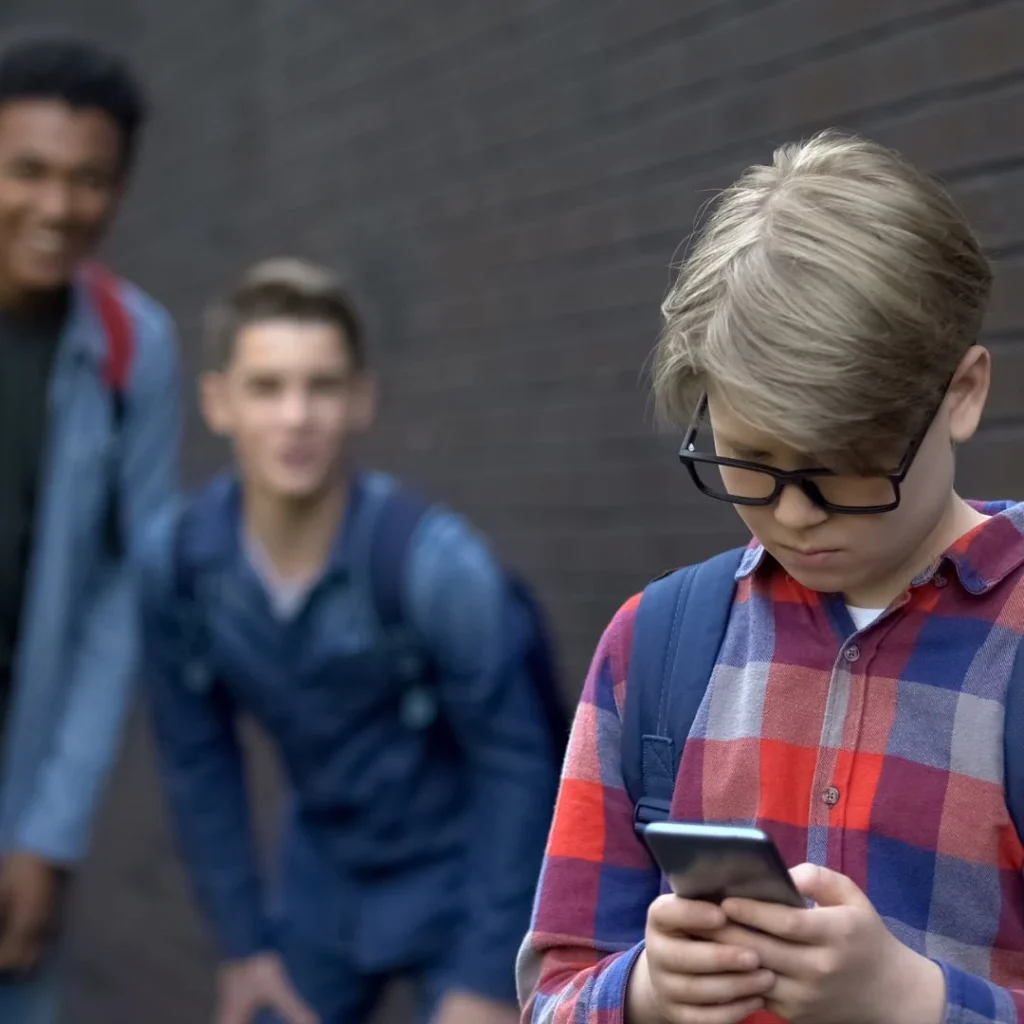
October marks National Bullying Prevention Month, and if you parent or care for a child, the topic of bullying in school may stir up a quiet flicker of worry. Maybe it sounds like I hope this never happens to my kid. Maybe it sounds like I think it might be happening right now.
Working with kids and teens in both a therapy office and a school counseling office gives me a close-up view of bullying in school from two angles. Both settings have taught me the same lesson: bullying does more than disrupt behavior. It threatens safety. Kids can’t learn, connect, or feel like themselves when they don’t feel safe around their peers.
That ties closely to last month’s topic. If connection protects, bullying attacks one of the things that protects most directly. This month, we look at what has stayed the same, what has changed, and how you can become the steady adult your child needs.
What Counts As Bullying In School?
Not every unkind moment qualifies, and the distinction matters. The CDC defines bullying as unwanted aggressive behavior by another young person or group that involves a real or perceived power imbalance and repeats, or seems highly likely to repeat (Gladden et al., 2014). Hold onto three pieces: the behavior feels unwanted, it involves a power imbalance, and it repeats.
A single argument between friends, or a mean comment in a heated moment, hurts but usually reflects conflict. Bullying follows a pattern in which one child holds more power and uses it against another. Our caregiver handout this month includes a quick reference to help you tell the two apart.
What Hasn’t Changed
Bullying may look different than it did when you attended school, but its core stays remarkably familiar.
It still centers on power and belonging. Bullying targets status and who gets to feel included. Kids who stand out in any way often face more risk, whether they arrive new, act shy, feel anxious, think differently, identify as LGBTQ+, or simply land in the wrong spot as friend groups shift.
It happens more often than many parents realize. About 19% of U.S. students ages 12 to 18 reported bullying at school in 2021–22, including 26% of middle schoolers and 16% of high schoolers. Students most often reported getting made fun of, called names, or insulted (National Center for Education Statistics [NCES], 2024a).
It often stays quiet. More often than shoving, it looks like name-calling, rumors, or being frozen out of a lunch table. These wounds hurt just as much and slip past adults far more easily.
Kids still don’t always tell. Only 44% of bullied students told an adult (NCES, 2024b). In our experience, shame, fear of making things worse, and worry about losing independence keep many kids quiet.
Bystanders still matter. Bullying rarely happens in a vacuum. Research on peer groups shows that bystander responses can feed bullying or help end it (Salmivalli, 2010). One classmate who sits beside a targeted kid, or says “not cool,” can shift the whole dynamic.
The impact still runs deep. Bullying victimization links to depression, anxiety, and thoughts of suicide, and the effects can last well beyond the school years (Moore et al., 2017).
What Has Changed
No off switch exists. Bullying in school used to end at the bus stop. Now it can follow a child into their bedroom at 11 p.m. Teens who say they stay online almost constantly report more online harassment than teens who go online less (53% vs. 40%; Vogels, 2022).
It reaches further than many of us assume. Nearly half of U.S. teens (46%) have experienced at least one of six cyberbullying behaviors, most commonly offensive name-calling (32%), false rumors (22%), and unwanted explicit images (17%; Vogels, 2022). Older teen girls report the highest rates: 54% of girls ages 15 to 17 (Schaeffer, 2023).
It lasts and spreads. A cruel comment used to reach a few people who happened to overhear it. Now someone can screenshot, forward, and store it, and an audience of two can grow to two hundred in minutes.
A screen makes cruelty easier. Anonymity and the absence of a face loosen the usual social brakes (Suler, 2004). Kids may type things they would never say in person.
It hides more easily. Getting left on read, removed from a group chat, or targeted by a “joke” meme can devastate a child and resist proof. Adults often can’t see any of it, and the child on the receiving end may lack language for it.
Images get created and circulate. AI tools now let kids alter photos and audio with a few taps. Common examples include apps that turn an ordinary photo into a fake nude or sexualized image, “deepfake” videos or voice clips that make a peer appear to say or do something they never did, and mocking memes or cartoons built from someone’s face. Fake images cause real harm, whether or not anyone believes them. If someone shares or makes an intimate or sexualized image of your child, save the evidence, report it to the platform and the school, and use the free Take It Down tool from the National Center for Missing & Exploited Children to help remove it (NCMEC, n.d.).
Signs Of Bullying In School To Watch For
Kids rarely announce that they face bullying. It tends to show up as a change from their usual self. What you notice depends less on grade level than on your child’s temperament, developmental stage, and whether they carry their own phone, and the signs overlap across ages.
Younger kids often show it through their bodies and behavior: stomachaches or headaches on school mornings, clinginess, tears, or complaints that no one played with them at recess. As kids grow into their tween years, you might notice shifting friend groups, more mood swings, or sudden secrecy around devices. As they grow into their teen years and get their own phones, signs can turn quieter still: withdrawal, an “I don’t care anymore” shrug, or accounts that vanish overnight.
Signs that can appear at any age include:
- Avoiding school, the bus, the cafeteria, or certain classes
- Changes in sleep or appetite
- Losing interest in things they used to love
- A drop in grades or motivation
- Seeming upset after looking at their phone, or suddenly avoiding it
- Torn, damaged, or missing belongings
- Talking about feeling worthless, hopeless, or like a burden
No single sign confirms bullying, and each has other possible explanations (U.S. Department of Health and Human Services, n.d.). Watch the pattern, and the shift from your child’s baseline.
How To Respond: Lead With Connection
Start with self-regulation, not questions. Your child watches your reaction. If they see alarm or anger, many kids stop sharing to protect you, or themselves. Try: “I’ve noticed you seem down lately. I won’t freak out, and I won’t do anything without talking with you first. I just want to understand.”
Listen, then reflect. Try “That sounds really painful” or “Thank you for telling me.” Resist the urge to fix it right away. Many kids need to feel heard before they can think about solutions.
Skip the lines that dismiss. “Just ignore them.” “Toughen up.” “Fight back.” “Kids can be mean.” “What did you do to make them act that way?” Even well-meant, these can tell a child their pain doesn’t matter or that they caused it. Most experts also advise against contacting the other child’s parents on your own, which can escalate the situation and cost you your child’s trust (U.S. Department of Health and Human Services, n.d.).
Give your child a say. Ask: “Do you want me to just listen, or help figure out next steps?” or “What would help most right now?” Of course, depending on your child’s age and stage and the nature of the bullying, you may need to get involved, especially when safety hangs in the balance. You can still give your child a say in how you get involved: who you contact, what you share, and what you ask for. Bullying strips away a sense of control. Handing some back starts the repair.
Save evidence before blocking. Take screenshots that show dates and usernames, then block and report. Adjust settings or mute accounts with your child instead of taking the device away. Digital spaces also give many isolated kids a place to find their people, so losing the phone can feel like punishment to the child who got targeted.
From The Counselor’s Office: Working With The School
Schools want to know about bullying in school, and reports land best when they stay specific, written, and respectful. Include what happened, when, who took part, where it happened (in person, a group chat, a game), any screenshots, and how it has affected your child. Send it to the school counselor or an administrator, and say what you hope for: a safety plan, a regular check-in, a seating or schedule change.
Ask who will serve as your point person and when to expect follow-up, and follow up kindly and persistently if you don’t hear back. Because many kids fear adults will “make it a big thing,” tell your child before you reach out and involve them in deciding what to ask for.
The Other Side Of The Equation
Kids who bully still count as kids, and they need support. Some carry their own hurt or feel pressure around status; others have learned that cruelty works socially. If your child causes harm, respond with calm accountability: name the behavior and its impact, work on repair, and get curious about what sits underneath.
When To Seek More Support
Bullying in school can weigh heavily on a child who carries it silently. Reach out to a professional if distress lasts more than a couple of weeks, if your child avoids school or activities, if sleep, appetite, or mood shifts noticeably, or if they say they feel like a burden or wish they weren’t here. If you ever worry about your child’s safety, the 988 Suicide & Crisis Lifeline offers call or text support any time (Substance Abuse and Mental Health Services Administration, 2024).
Therapy gives a child a place to feel heard, rebuild confidence, and practice ways to respond, and it serves more than crisis. If your child has felt disconnected, our post on peer connection at every age pairs well with this one.
Two Free Resources To Support Your Family This Month
For Kids: What’s Really True About You?
A kid-friendly activity that helps children spot the put-downs bullies use and answer back with what’s really true about them, through affirmations they can choose, personalize, and keep.
For Parents & Caregivers: Talking with Your Child about Bullying
A printable one-pager with conversation starters, a “what to say / what to skip” guide, and a quick-reference box that helps you tell bullying (repeated, imbalanced power, intent to harm) from conflict (mutual and situational).
Talking With Your Child About Bullying: A Caregiver’s Guide
Use these as conversation starters rather than a checklist to complete.
Your Child Doesn’t Need A Perfect Response
Your child doesn’t need you to solve bullying in school perfectly. They need to know they don’t face it alone. Steady presence and a willingness to keep showing up matter more than any single script.
References
Gladden, R. M., Vivolo-Kantor, A. M., Hamburger, M. E., & Lumpkin, C. D. (2014). Bullying surveillance among youths: Uniform definitions for public health and recommended data elements, version 1.0. Centers for Disease Control and Prevention and U.S. Department of Education.
Moore, S. E., Norman, R. E., Suetani, S., Thomas, H. J., Sly, P. D., & Scott, J. G. (2017). Consequences of bullying victimization in childhood and adolescence: A systematic review and meta-analysis. World Journal of Psychiatry, 7(1), 60–76. https://doi.org/10.5498/wjp.v7.i1.60
National Center for Education Statistics. (2024a). Bullying at school and electronic bullying. Condition of Education. U.S. Department of Education. https://nces.ed.gov/programs/coe/indicator/a10/bullying-electronic-bullying
National Center for Education Statistics. (2024b). Student reports of bullying: Results from the 2022 School Crime Supplement to the National Crime Victimization Survey (NCES 2024-109). U.S. Department of Education. https://nces.ed.gov/pubs2024/2024109.pdf
National Center for Missing & Exploited Children. (n.d.). Take It Down. https://takeitdown.ncmec.org
Salmivalli, C. (2010). Bullying and the peer group: A review. Aggression and Violent Behavior, 15(2), 112–120. https://doi.org/10.1016/j.avb.2009.08.007
Schaeffer, K. (2023, November 17). 9 facts about bullying in the U.S. Pew Research Center. https://www.pewresearch.org/short-reads/2023/11/17/9-facts-about-bullying-in-the-us/
Substance Abuse and Mental Health Services Administration. (2024). 988 Suicide & Crisis Lifeline. https://988lifeline.org
Suler, J. (2004). The online disinhibition effect. CyberPsychology & Behavior, 7(3), 321–326. https://doi.org/10.1089/1094931041291295
U.S. Department of Health and Human Services. (n.d.). Warning signs for bullying. StopBullying.gov. https://www.stopbullying.gov/bullying/warning-signs
Vogels, E. A. (2022, December 15). Teens and cyberbullying 2022. Pew Research Center. https://www.pewresearch.org/internet/2022/12/15/teens-and-cyberbullying-2022/